

Can you wheel a wheelchair on grass?
Wheeling a wheelchair on grass can be challenging and requires more effort than moving on a flat surface. The wheels can sink into the ground, making it difficult to move forward. However, it is possible to wheel a wheelchair on grass with the right technique and equipment. Wide wheels or inflatable tires can help distribute the weight and prevent sinking. Pushing with a steady and rhythmic motion can also help maintain momentum. It is important to be cautious and avoid steep slopes or uneven terrain to prevent accidents.
Do grass protection mats work?
Yes, grass protection mats can be effective in preventing damage to grass from heavy foot traffic or vehicle use. The mats distribute the weight of the load, reducing soil compaction, and preventing rutting. They also provide a stable and even surface, which can improve traction and prevent slips and falls. The mats allow the grass to grow through the holes, maintaining a natural look while reducing erosion. However, it is important to select the appropriate type and size of mat for the intended use and to follow the manufacturer's instructions for installation and maintenance.
What is the best outdoor surface for wheelchairs?
When it comes to outdoor surfaces for wheelchairs, the best option is a smooth and even surface with minimal slopes and obstacles. Concrete or asphalt surfaces are ideal for wheelchair users as they are smooth, durable and provide good traction. However, these surfaces can become hot in the sun, which can be uncomfortable for the user. Another good option is pavers or bricks, which are also smooth and provide good traction. However, they may be more difficult to navigate for some wheelchair users due to the uneven surface. Natural surfaces such as compacted gravel or dirt paths may also be suitable but may require more effort to navigate due to the uneven surface.
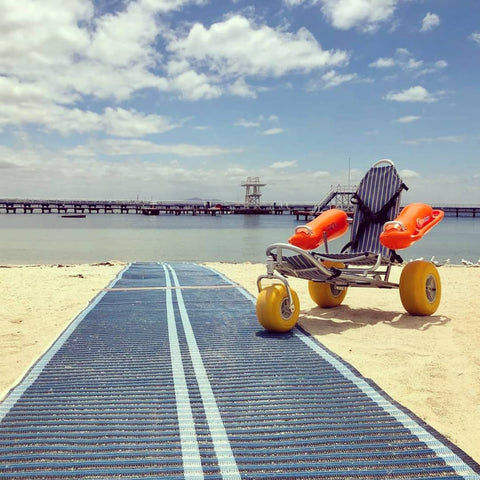
Mobi-mat is another option. It is a portable, roll-out walkway that is designed to provide a stable, level surface for wheelchair users for areas that would otherwise be difficult to navigate. It is durable, easy to install and remove, and requires low-maintenance.
It is important to choose a surface that is appropriate for the user's needs and abilities.
Can electric wheelchairs go on grass?
Yes, electric wheelchairs can go on grass if the terrain is not too rough or steep. However, it is important to note that grass can be difficult to navigate for some electric wheelchair users due to the uneven and soft surface. For this reason, it is recommended to choose a smooth and even surface whenever possible. If you need to use an electric wheelchair on grass, it is important to consider the type of wheels on the chair. Larger wheels with treads will provide better traction on grass, while smaller wheels may sink into the ground. Additionally, it is important to be cautious of any obstacles or uneven terrain, which can increase the risk of tipping or getting stuck. An matting solution such as Mobi-mat can also be also considered. The mat will create a safe and even surface and allows the electric wheelchairs to maneuver.
How do I make my backyard wheelchair accessible?
Making a garden wheelchair accessible involves creating a smooth and even surface for the wheelchair to navigate, removing any obstacles that may be in the way, and ensuring that the garden is designed with accessibility in mind. Here are some tips for making a garden wheelchair accessible:
- 1. Create a smooth and even path: Use materials such as concrete, pavers, matting or decking to create a smooth and even path throughout the garden. Avoid using materials such as gravel or loose stones that may be difficult for wheelchair users to navigate.
- 2. Provide adequate turning space: Ensure that there is enough space for the wheelchair to turn around, with a minimum turning circle of 1.5 meters / 5 feet.
- 3. Remove obstacles: Remove any obstacles such as low-hanging branches, rocks, or garden furniture that may be in the way.
- 4. Create raised garden beds: Consider creating raised garden beds that are accessible from a seated position, with a maximum height of 80cm.
- 5. Provide seating areas: Include seating areas throughout the garden, with benches or chairs that are at a comfortable height for wheelchair users.
- 6. Ensure good lighting: Ensure that the garden is well-lit, with lighting that is accessible from a seated position.
- 7. Consider water features: If you include water features such as a pond or fountain, ensure that they are designed with safety in mind and are accessible to wheelchair users.
